
Introduction to Programming using BASIC

During my NYSC service, I was deployed to Imo State. I ended up at a Christian continuing education school where I taught BASIC programming and Spreadsheet (using Lotus 123).

I came up with a condensed 19-page book/manual to teach the BASIC class.

I am uploading it here since a smart person I who is learning Python with very little computing background, said it was very hard. Hopefully it is a gentler introduction to programming since BASIC is considered the easiest programming language to learn*

There are many ways to get a BASIC interpreter (or compiler) – the application that runs your BASIC program after you write them, but I recommend QB64 since it is easy to setup (i.e., download the compressed/zip file; extract it to a place on your Windows system, launch/execute it by double-clicking on the qb64.exe application file in the extracted folder. I suggest renaming the extracted folder to something like qb64 – the default is way too long). You can immediately start typing your program into the editor. To run the program you have typed, press the F5 key on your keyboard and watch the magic happen!

*BASIC (Beginner’s All-purpose Symbolic Instruction Code) is widely considered one of the easiest programming languages to learn, especially for beginners. Its simple syntax and user-friendly commands make it accessible, and it’s often used to teach basic programming concepts.
Reference: https://www.reddit.com/r/learnprogramming/comments/dpbzxw/is_basic_a_good_programming_language_for/?rdt=64814

It’s only 1997

I found a CD containing some Visual Basic (VB5) codes I had written a while back (Surds and Arabic-to-Roman-Numerals) and decided to re-live what the IDE looked like then. I have never really been a programmer (People life Prof. Dayo, Shina and Adan “Java” come to mind) because if there is a word lighter than lightweight, that’s what I should use for the few codes I have written. I guess trivial is a better word as lightweight in programming has a completely different meaning

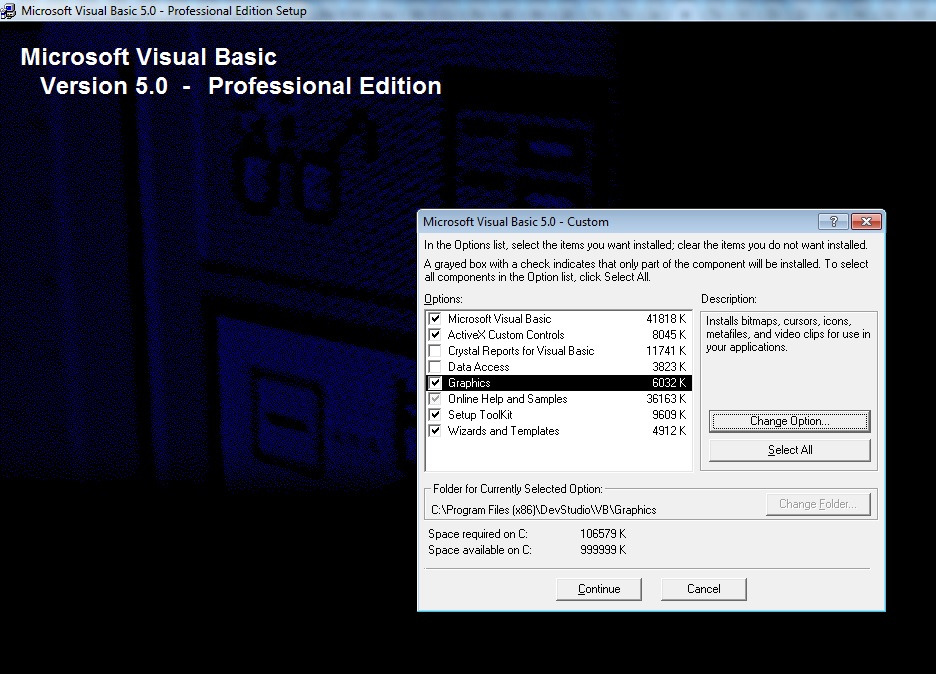
But that’s not the point of this post. It’s more to buttress the pace at which technology changes. I found Visual Basic 5 on the freedownloadmanager.org website under the Windows abandonware section and installed it on my system. During the installation, I came to the component selection screen below and was drawn to the meagre disk space requirement  (compared to the multi-GB requirements of some newer coding platforms).

Look at the screen-grab below and see if you can tell what’s odd before scrolling down:

It’s the “Space available on C:” value! It’s set to “999999 K” which is just under 1GB. I am too lazy to go check what sort of hard disk sizes were predominant in 1997 but I suspect, whoever wrote this part of the installer probably used a field with only 6 digits in it a la “640K ought to be enough for anybody.” quote by the big boss himself (Bill Gates). So I guess the logic would be something like “if we get some value back that overruns the field just set it to the max supported value which would be 999999 since it’s unlikely there will be many of those disks around. We can’t code for every negligible corner case right?”
I am not berating the programmers: I just wanted to use it to point out the rapid pace of technological development.

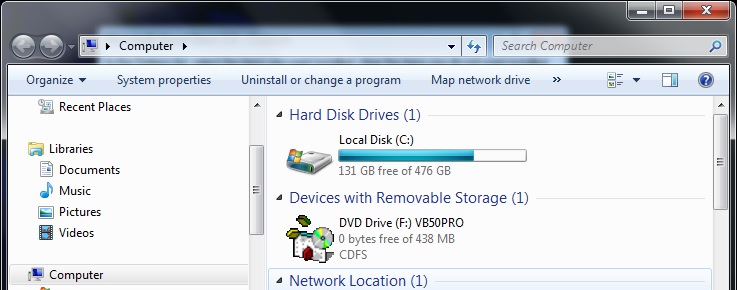
The laptop I installed it on had a 476GB Hard Disk Drive (HDD) with 131GB free space. Since that field in the installer was expressed in KiloBytes (KB), they would have required 9 digits instead of the 6. People code smarter now of course. “Human-friendly form” would result in the value been converted to GB or TB (etc) which reduces the field’s required number of digits.

And the VB5 IDE was just 20 years ago. Of course in computing, that’s another era/lifetime.

End Note: Bill Gates has always denied ever making the statement above. So why didn’t I remove it? Some things are part of computing lore. That quote is one of them.